
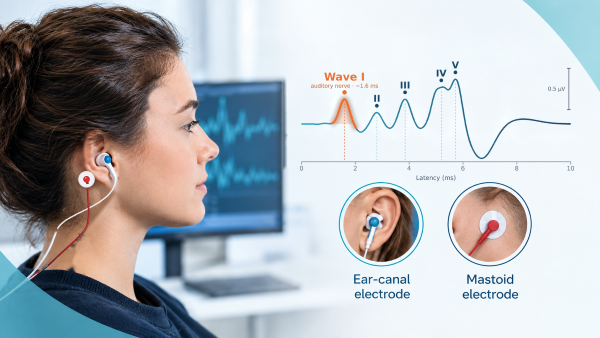
Our team has published a new study in the International Journal of Audiology, in collaboration with EuroMov Digital Health in Motion (University of Montpellier, IMT Mines Alès). The study evaluates the test–retest reliability of Auditory Brainstem Response (ABR) Wave I recordings using ear-canal and mastoid electrodes in healthy young adults.
Why Wave I reproducibility matters
Wave I reflects the synchronous activity of the auditory nerve and is a promising candidate biomarker for investigating cochlear synaptopathy, the loss of synaptic connections between inner hair cells and auditory nerve fibres.
Because cochlear synaptopathy may not be detected by standard hearing tests, it is often discussed in the context of “hidden hearing loss”. Wave I amplitude has therefore attracted interest as a potential non-invasive electrophysiological marker of this damage in humans. Wave I amplitude has therefore attracted interest as a potential non-invasive electrophysiological marker of this damage in humans.
For a biomarker to support clinical research and longitudinal monitoring, its reproducibility must be established. Researchers need to distinguish genuine changes in auditory function from normal measurement variability. Yet published estimates of Wave I test–retest reliability remain variable, highlighting the need for robust, standardised measurement protocols.
How we designed the study
Thirty normal-hearing adults aged 18 to 25 took part in four recording sessions, two weeks apart. Click-evoked ABRs were recorded at 80 dB nHL using two montages: an ear-canal electrode (tiptrode) and a mastoid electrode.
The first three sessions were conducted by the same tester while a second tester conducted the fourth. This design allowed us to separate within-tester from between-tester variability, which most previous studies, based on two sessions only, could not do. ECG and respiration were also recorded during each session to explore physiological sources of variability.
Key findings
- Good reliability of Wave I amplitude, higher for ear-canal recordings (ICC = 0.80 [95% CI: 0.61–0.88]) than for mastoid recordings (ICC = 0.77), with a within-ear coefficient of variation of 12–14%.
- High consistency in Wave I latency, with a coefficient of variation of only 2–3% across sessions.
- A limited tester effect: tester-related variance never exceeded 8.7% of total variance, below residual within-ear variance. This supports the feasibility of multi-tester and multicentre protocols.
- An objective quality criterion: a signal-to-noise ratio threshold retained around 85% of recordings while excluding low-quality signals.
- Improved amplitude characterisation: Accounting for head size and residual noise reduced the central 95% range of amplitude measurements by 18%, although substantial interindividual variability remained.
What this means for auditory biomarker research
These findings provide important reference data for the interpretation of ABR Wave I measurements and support their use in longitudinal research protocols. They also highlight the importance of standardised recording conditions, signal-quality criteria and appropriate adjustment for individual characteristics when assessing changes in auditory function.
For Cilcare, this work reflects our commitment to combining auditory science, robust experimental methods and quantitative analysis to advance the characterisation of auditory biomarkers for clinical research.
The next challenge is to determine whether Wave I amplitude can reliably distinguish pathological changes from normal physiological variability in clinical populations, including people with suspected cochlear synaptopathy.
Read the article
Duval B. et al. (2026). Test–retest reliability and agreement of ear-canal and mastoid Wave I Auditory Brainstem Responses in healthy young adults. International Journal of Audiology. https://doi.org/10.1080/14992027.2026.2743351
eprint link : https://www.tandfonline.com/eprint/A73X5Z3AP3GEZDTC4EJF/full?target=10.1080/14992027.2026.2743351
We warmly thank the EuroMov DHM team for hosting the study in their research facilities, as well as all participants and co-authors who made this work possible.
